
Learn Salesforce with GradX
Ai Enabled Salesforce Training
Admin + Apex + LWC + Agentforce + AI Tools
- Join the Next Cohort of SFDC

4.9 from 1500+ reviews
- Configure and manage complete Salesforce solutions.
- Build secure and scalable applications using Apex and LWC.
- Design automation using Flows, Triggers, and Approval Processes.
- Develop and consume REST APIs for system integrations.
- Implement AI-enabled solutions within Salesforce.
- Build intelligent agents using Agentforce and Prompt Builder.
- Deliver end-to-end real-time and capstone projects.
- Prepare confidently for technical interviews and Salesforce career roles.
Learning format
Online/Offline
Duration
4.5 months
Learning Pattern
Live Lectures
Recordings
Lifetime Access
Learn from the top 1% instructors and mentors from leading tech companies






Follow this path to become a
Rockstar Developer
Getting into the Course
Upgrade Your Salesforce Skills for 2026 and Beyond.
GradX Academy’s Salesforce Admin, Development, and AI-Enabled Course is designed to prepare you for the modern Salesforce ecosystem, covering Admin, Apex, Lightning Web Components (LWC), Integrations, and Agentforce. You will learn how to configure secure and scalable solutions, develop enterprise-grade applications, build real-time integrations, and implement AI-powered features within Salesforce. In addition, you will receive structured interview preparation, project guidance, and career support to help you confidently transition into high-demand roles in the Salesforce and AI domain.
Enroll today and start your journey to becoming a Salesforce expert!
What you’ll learn


Course Details
MODULE 1: Salesforce Platform Fundamentals
- Introduction to Salesforce CRM
- Salesforce Ecosystem & Clouds Overview
- Multitenant Architecture
- Salesforce Editions & Licenses
- Salesforce Environment Setup (Org, Sandbox)
- Standard Objects vs Custom Objects
- Salesforce UI & Navigation
MODULE 2: User Security Model
- Users, Profiles & Permission Sets
- Role Hierarchy
- Login IP Restrictions
- Password Policies & Session Settings
- Permission Set Groups
- Delegated Administration
- Authentication Methods Overview
- SSO
- MFA
- SSO
- User Access Troubleshooting
MODULE 3: Data Model & Data Management
- Object Relationships
- Lookup
- Master-Detail
- Junction Objects
- Lookup
- Field Types & Field Dependencies
- Schema Builder
- Validation Rules
- Record Types & Page Layouts
- Data Import Wizard
- Data Loader
MODULE 4: Data Security Model
- Organization-Wide Defaults (OWD)
- Role Hierarchy vs Sharing
- Sharing Rules (Criteria-based & Owner-based)
- Manual Sharing
- Team-Based Access (Account, Opportunity, Case Teams)
- Field-Level Security (FLS)
- Record-Level Security
- Data Visibility Best Practices
- Real-Time Security Scenarios
MODULE 5: Salesforce Automation (Admin Perspective)
- Overview of Automation Tools
- Salesforce Flow (Core Focus)
- Screen Flows
- Record-Triggered Flows
- Scheduled Flows
- Autolaunched Flows
- Approval Processes
- Flow Security & Error Handling
- When to use Flow vs Apex
- Automation Best Practices
MODULE 6: Reports, Dashboards & Analytics
- Report Types (Standard & Custom)
- Tabular, Summary, Matrix & Joined Reports
- Dashboard Components
- Dynamic Dashboards
- Row-Level Security in Reports
- Report Subscriptions & Scheduling
MODULE 7: Salesforce Development Fundamentals
- Declarative vs Programmatic Development
- Salesforce MVC Architecture
- Introduction to Apex
- Apex Execution Context
- Governor Limits Overview
MODULE 8: Apex Programming
- Apex Syntax & Data Types
- Collections (List, Set, Map)
- SOQL & SOSL
- DML Operations
- Apex Exception Handling
- Bulkification & Performance Optimization
- Secure Coding Best Practices
MODULE 9: Triggers & Order of Execution
- Trigger Basics
- Before vs After Triggers
- Trigger Context Variables
- Salesforce Order of Execution
- Trigger Framework & Best Practices
Recursion Control Techniques
MODULE 10: Asynchronous Apex
- @Future Methods
- Queueable Apex
- Batch Apex
- Scheduled Apex
- Use Cases & Limits
- Error Handling & Monitoring
MODULE 11: Apex Security (Developer Perspective)
- Apex Sharing Keywords
- with sharing
- without sharing
- inherited sharing
- Enforcing CRUD & FLS in Apex
- Secure SOQL & DML
- Common Security Pitfalls
MODULE 12: Apex Testing & Debugging
- Test Classes & Code Coverage
- @isTest Annotation
- Test Data Factory
- SeeAllData Usage
- Debug Logs
- Deployment Readiness
MODULE 13: Lightning Web Components (LWC)
- Javascript Basics
- Introduction to LWC
- LWC Architecture
- LWC Component Bundle
- Component Lifecycle
- Data Binding & Events
- One-way Data Binding
- Two-way Data Binding
- Communication Between Component
- Parent to Child Communication
- Child to Parent Communication
- Unrelated Component Communication
- Apex Integration
- @wire Service
- Calling Apex Methods from LWC
- Imperative vs Wired Apex Calls
- Lightning Data Service (LDS)
- Advanced LWC Concepts
- Reusable Components
- Custom Labels
- Static Resources
- Custom Permissions in LWC
- Navigation Service
- Toast Notifications
- Performance Optimization
- LWC Security Best Practices
MODULE 14: Integrations & APIs
- Salesforce Integration Overview
- REST API Basics
- REST Architecture Concepts
- HTTP Methods:
- GET
- POST
- PUT
- DELETE
- HTTP Status Codes
- Apex Callouts (Outbound Integration)
- What is an Apex Callout?
- Making HTTP Callouts from Apex
- GET & POST Callouts
- Handling Request & Response
- Parsing JSON Response
- Exception Handling
- Callout Best Practices
- Inbound Integrations
- Exposing Salesforce Data using REST API
- Creating Apex REST Services
- @RestResource Annotation
- Handling Requests from External Systems
- Data Validation & Error Handling
- Named Credentials
- Connected Application
- Authentication Methods
- Username-Password Flow
- OAuth 2.0 (Overview)
- Testing APIs using Postman
- Connected Application
- Error Handling in Integrations
MODULE 15: AI-Enabled Salesforce Development
AI Development Tools for Salesforce
- Agentforce AI-Assisted Development
- Cursor AI for Code Generation and Refactoring
- GitHub Copilot and AI Coding Assistants
- OpenAI / ChatGPT Prompt Engineering
- Gemini Prompt Engineering
AI Productivity and Prompt Engineering
- Prompt Design Principles
- Structured Prompt Writing
- Generating Apex, LWC and Flow using AI
- Reviewing and Validating AI-Generated Code
Responsible AI Usage in Enterprise Projects
MODULE 16: Agentforce and Agents Builder
- Introduction to Agentforce Architecture
- Understanding AI within Salesforce Ecosystem
- Agent Lifecycle and Execution Flow
Agent Builder
- Creating Agents
- Configuring Agent Capabilities
- Managing Agent Behavior
Agent Context Variables
- Understanding Context Variables
- Context-Based Automation
Custom Actions
- Custom Actions using Apex
- Custom Actions using Flow
- Secure Action Execution
Prompt Engineering inside Salesforce
- Prompt Templates
- Prompt Builder
- Testing and Optimizing Prompts
AI Governance
- Data Security in AI
- Ethical AI Considerations
AI Implementation Best Practices
Where can you get job ?





















Getting into the Course
Upgrade Your Salesforce Skills for 2026 and Beyond.
Enroll today and start your journey to becoming a Salesforce expert!
What you’ll learn


Course Details
MODULE 1: Salesforce Platform Fundamentals
- Introduction to Salesforce CRM
- Salesforce Ecosystem & Clouds Overview
- Multitenant Architecture
- Salesforce Editions & Licenses
- Salesforce Environment Setup (Org, Sandbox)
- Standard Objects vs Custom Objects
- Salesforce UI & Navigation
MODULE 2: User Security Model
- Users, Profiles & Permission Sets
- Role Hierarchy
- Login IP Restrictions
- Password Policies & Session Settings
- Permission Set Groups
- Delegated Administration
- Authentication Methods Overview
- SSO
- MFA
- SSO
- User Access Troubleshooting
MODULE 3: Data Model & Data Management
- Object Relationships
- Lookup
- Master-Detail
- Junction Objects
- Lookup
- Field Types & Field Dependencies
- Schema Builder
- Validation Rules
- Record Types & Page Layouts
- Data Import Wizard
- Data Loader
MODULE 4: Data Security Model
- Organization-Wide Defaults (OWD)
- Role Hierarchy vs Sharing
- Sharing Rules (Criteria-based & Owner-based)
- Manual Sharing
- Team-Based Access (Account, Opportunity, Case Teams)
- Field-Level Security (FLS)
- Record-Level Security
- Data Visibility Best Practices
- Real-Time Security Scenarios
MODULE 5: Salesforce Automation (Admin Perspective)
- Overview of Automation Tools
- Salesforce Flow (Core Focus)
- Screen Flows
- Record-Triggered Flows
- Scheduled Flows
- Autolaunched Flows
- Approval Processes
- Flow Security & Error Handling
- When to use Flow vs Apex
- Automation Best Practices
MODULE 6: Reports, Dashboards & Analytics
- Report Types (Standard & Custom)
- Tabular, Summary, Matrix & Joined Reports
- Dashboard Components
- Dynamic Dashboards
- Row-Level Security in Reports
- Report Subscriptions & Scheduling
MODULE 7: Salesforce Development Fundamentals
- Declarative vs Programmatic Development
- Salesforce MVC Architecture
- Introduction to Apex
- Apex Execution Context
- Governor Limits Overview
MODULE 8: Apex Programming
- Apex Syntax & Data Types
- Collections (List, Set, Map)
- SOQL & SOSL
- DML Operations
- Apex Exception Handling
- Bulkification & Performance Optimization
- Secure Coding Best Practices
MODULE 9: Triggers & Order of Execution
- Trigger Basics
- Before vs After Triggers
- Trigger Context Variables
- Salesforce Order of Execution
- Trigger Framework & Best Practices
Recursion Control Techniques
MODULE 10: Asynchronous Apex
- @Future Methods
- Queueable Apex
- Batch Apex
- Scheduled Apex
- Use Cases & Limits
- Error Handling & Monitoring
MODULE 11: Apex Security (Developer Perspective)
- Apex Sharing Keywords
- with sharing
- without sharing
- inherited sharing
- Enforcing CRUD & FLS in Apex
- Secure SOQL & DML
- Common Security Pitfalls
MODULE 12: Apex Testing & Debugging
- Test Classes & Code Coverage
- @isTest Annotation
- Test Data Factory
- SeeAllData Usage
- Debug Logs
- Deployment Readiness
MODULE 13: Lightning Web Components (LWC)
- Javascript Basics
- Introduction to LWC
- LWC Architecture
- LWC Component Bundle
- Component Lifecycle
- Data Binding & Events
- One-way Data Binding
- Two-way Data Binding
- Communication Between Component
- Parent to Child Communication
- Child to Parent Communication
- Unrelated Component Communication
- Apex Integration
- @wire Service
- Calling Apex Methods from LWC
- Imperative vs Wired Apex Calls
- Lightning Data Service (LDS)
- Advanced LWC Concepts
- Reusable Components
- Custom Labels
- Static Resources
- Custom Permissions in LWC
- Navigation Service
- Toast Notifications
- Performance Optimization
- LWC Security Best Practices
MODULE 14: Integrations & APIs
- Salesforce Integration Overview
- REST API Basics
- REST Architecture Concepts
- HTTP Methods:
- GET
- POST
- PUT
- DELETE
- HTTP Status Codes
- Apex Callouts (Outbound Integration)
- What is an Apex Callout?
- Making HTTP Callouts from Apex
- GET & POST Callouts
- Handling Request & Response
- Parsing JSON Response
- Exception Handling
- Callout Best Practices
- Inbound Integrations
- Exposing Salesforce Data using REST API
- Creating Apex REST Services
- @RestResource Annotation
- Handling Requests from External Systems
- Data Validation & Error Handling
- Named Credentials
- Connected Application
- Authentication Methods
- Username-Password Flow
- OAuth 2.0 (Overview)
- Testing APIs using Postman
- Connected Application
- Error Handling in Integrations
MODULE 15: AI-Enabled Salesforce Development
AI Development Tools for Salesforce
- Agentforce AI-Assisted Development
- Cursor AI for Code Generation and Refactoring
- GitHub Copilot and AI Coding Assistants
- OpenAI / ChatGPT Prompt Engineering
- Gemini Prompt Engineering
AI Productivity and Prompt Engineering
- Prompt Design Principles
- Structured Prompt Writing
- Generating Apex, LWC and Flow using AI
- Reviewing and Validating AI-Generated Code
Responsible AI Usage in Enterprise Projects
MODULE 16: Agentforce and Agents Builder
- Introduction to Agentforce Architecture
- Understanding AI within Salesforce Ecosystem
- Agent Lifecycle and Execution Flow
Agent Builder
- Creating Agents
- Configuring Agent Capabilities
- Managing Agent Behavior
Agent Context Variables
- Understanding Context Variables
- Context-Based Automation
Custom Actions
- Custom Actions using Apex
- Custom Actions using Flow
- Secure Action Execution
Prompt Engineering inside Salesforce
- Prompt Templates
- Prompt Builder
- Testing and Optimizing Prompts
AI Governance
- Data Security in AI
- Ethical AI Considerations
AI Implementation Best Practices
Course Details







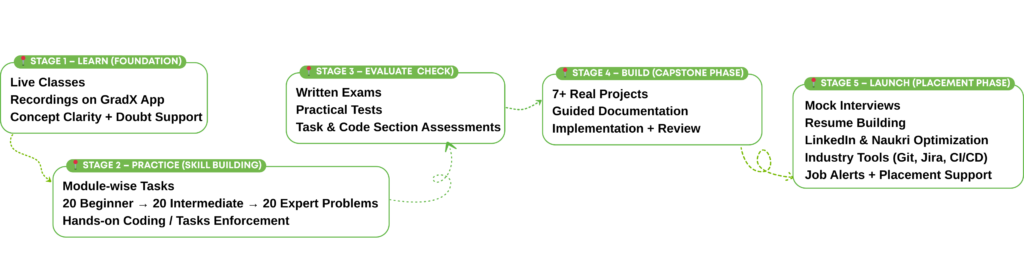
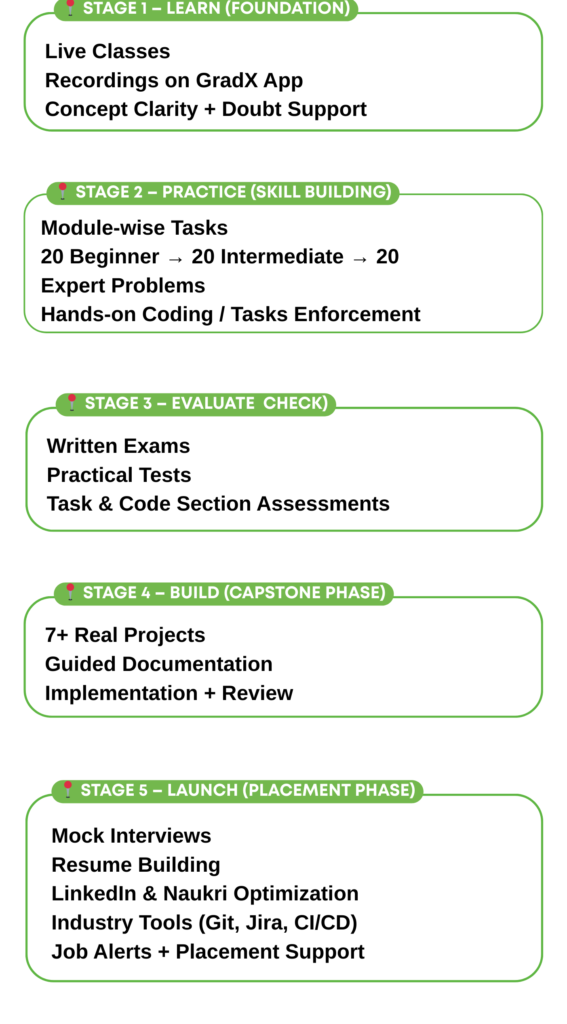
Our Training Execution Model
Meet Your Coaches
100+ Hours Of 1 On 1 Live Coaching With Top Industry Experts Mentors
Shubham Shendre
7+ years Experience in SFDC
Shubham Shendre is the founder of GradX and a Salesforce expert with7+ years of experience. He has led impactful masterclasses on Salesforce and contributed to the Salesforce ecosystem through his expertise in Sales, Service, and Marketing Cloud.

Vaibhav Bode
7+ years Experience in SFMC
Vaibhav Bode has over seven years of experience in Salesforce Marketing Cloud, specializing in designing impactful marketing solutions. He is known for his expertise in SFMC and for driving success through personalized customer engagement strategies.

WHY GRADX?
EXPLORE JOB PLACEMENT PREPARATION PLAN
See How Mahendra got 22 LPA (300% Hike)with GradX Preparation Plan
See How Mahendra got 22 LPA (300%) Hike with GradX Preparation Plan
Explore how our single, intelligent platform puts AI to work across your business, freeing people for work that matters.
While we’re confident in the effectiveness of our training and the skills you’ll gain, we don’t offer guaranteed job placement. Our primary focus is to equip you with the knowledge, hands-on experience, and industry readiness through comprehensive curriculum, mock interviews, and career guidance. Ultimately, landing your dream job depends on various factors, including your individual efforts, market conditions, and interview performance. However, we’re committed to providing you with all the support and resources needed to ace your job search.
Absolutely! Mock interviews are an integral part of our training program. Regular mock interviews throughout the course simulate real-world scenarios, giving you invaluable practice and feedback on your communication, technical skills, and presentation. This prepares you to confidently face actual interviews and make a strong impression on hiring managers.
- Expert instructors: Our faculty consists of industry professionals with extensive experience who share their knowledge and insights in a practical and engaging manner.
- Dedicated mentors: Get personalized guidance and support from dedicated mentors who will answer your questions, track your progress, and offer tailored advice.
- Active community: Connect with fellow learners and instructors through online forums, discussions, and networking events. Share experiences, support each other, and build valuable connections.
- Career services: We guide you through the entire job search process, from resume writing and interview preparation to connecting you with industry opportunities.
We believe in lifelong learning, so once you enroll with GradX Academy, you get lifetime access to all the course materials, including videos, presentations, exercises, and practice tests. This allows you to revisit the content at any time, refresh your memory, and continue honing your skills even after completion.
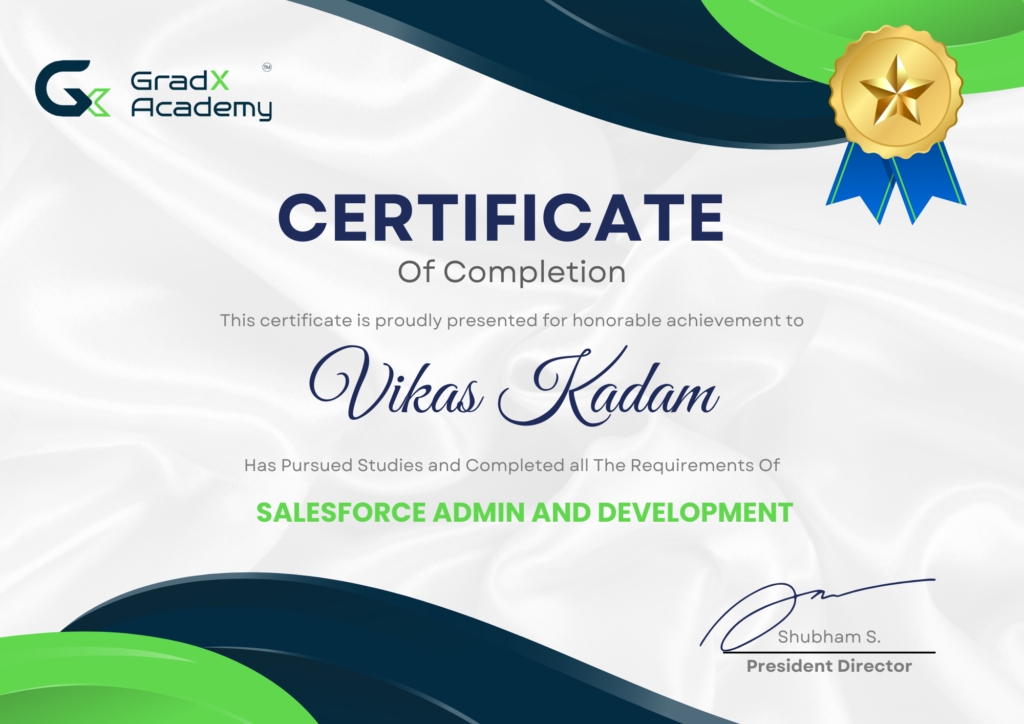

Industry Recognised Certification

Get Realtime Hands on Experience
Get started with GradX Academy
